Shaldon Botanical Gardens
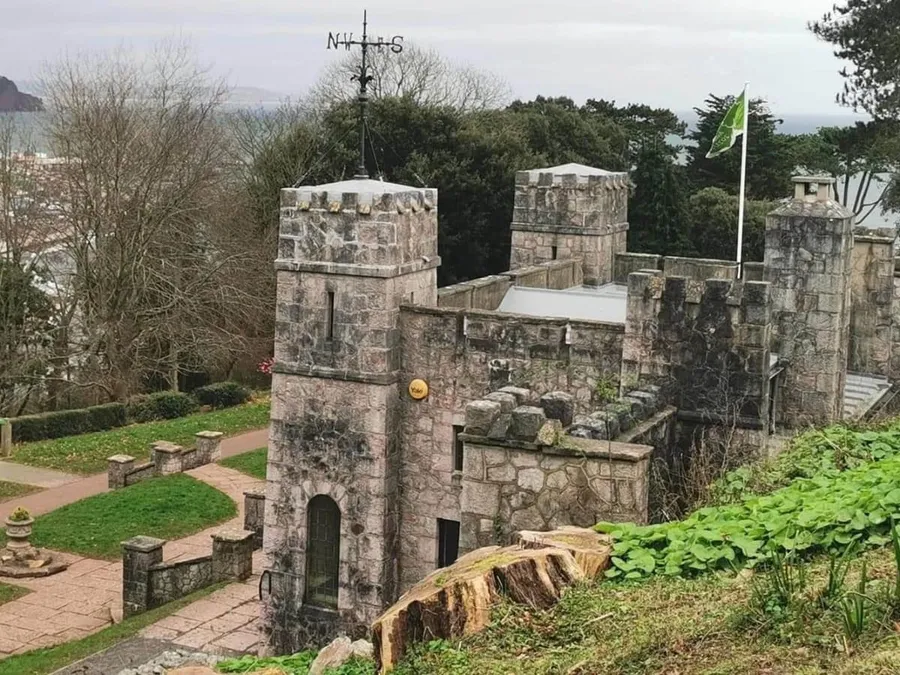
Shaldon Botanical Gardens occupy a prominent position on a hillside directly above the village, delivering far-reaching vistas over the Teign estuary. The site transforms a once-private estate into a public space where layered terraces and winding paths reveal the natural contours of the land. Mature trees dominate the planting, forming an arboretum that includes specimens chosen for their form and resilience in coastal conditions.
The gardens trace their origins to the late 1920s and early 1930s, when Maria Laetitia Kempe Homeyard commissioned their construction on a series of sloping fields.
Working with designer William Sears, she shaped an informal layout that incorporated existing gradients rather than imposing rigid geometry. The result is a series of connected levels where visitors move between open grassy areas and sheltered pockets defined by stone walls and rockeries.
A small castle folly stands as the central architectural feature, built as a whimsical eyecatcher that frames views towards the water.
Nearby, a pond fed by a rill provides a quiet water element, while the Italianate rockery showcases plants suited to dry, sunny aspects. The Burma Star rose garden adds seasonal colour against the predominant green of the tree canopy. Weeping hazel trees contribute distinctive silhouette, particularly when their branches trail in the breeze.
Paths follow the hillside in two long east-west routes linked by shorter north-south sections, many involving steps. Benches positioned at regular intervals allow pauses to take in the changing perspectives across the estuary. The design encourages unhurried progression, with each turn opening fresh sightlines towards the river mouth or the open sea beyond.
The gardens remain open to the public without charge and benefit from ongoing care by a dedicated volunteer group alongside council support. Restoration work has preserved original stonework and replanted areas to maintain the balance between cultivated sections and natural woodland feel.
Tree labels and a trail leaflet help identify notable specimens, adding an educational layer to a straightforward walk. The combination of elevation, varied planting, and sheltered corners creates distinct atmospheres across the site, from exposed upper terraces catching sea breezes to lower areas screened by foliage.
The gardens function effectively as a transitional space between village and coastline, where the shift in height alters perspective dramatically. Coastal influences shape the plant selection, favouring species that tolerate salt-laden air and exposed conditions. The overall effect is one of restrained planting that allows the topography and views to remain the primary focus.
Shaldon Botanical Gardens
Torquay Road
Shaldon
TQ14 0BH